

How To Lock Settings On Android Phone

By , Contributing Editor, Computerworld |
About |
Not your average Android news — a diverse mix of communication, insight, and analysis with veteran Android journalist JR Raphael.
Android Intelligence Advice
12 Android settings that'll strengthen your security
Some of the most important Android settings are also the most cached — and they're absolutely worth your while to uncover and put into action.
Y'all might non know it from all the panic-inducing headlines out at that place, simply Android is actually packed with practical and powerful security options. Some are activated by default and protecting you whether you lot realize it or not, while others are more out of the way but equally deserving of your attention.
So stop wasting your time worrying nearly the Android malware monster du jour and which security company is using it to scare yous into an unnecessary subscription, and take a moment instead to look through these far more than impactful Android settings — ranging from core system-level elements to some more than avant-garde and easily overlooked options.
Make your manner through these 12 specific Android settings, so make your way over to my Android Intelligence newsletter to get iii exclusive bonus tips on your favorite field of study this 2d.
Prepare? Ready. Permit'southward do this:
Android setting No. 1: App permissions
A rarely spoken reality of Android security is that your own negligence — either in failing to properly secure your device in some style or in leaving open as well many windows that allow 3rd-political party apps access to your info — is far more than likely to be problematic than any manner of malware or scary-sounding boogeyman.
So let'south address the showtime part of that right off the bat, shall we? Despite what some sensational stories might pb you to believe, Android apps are never able to access your personal data or any part of your phone unless yous explicitly give 'em the go-ahead to practise so. And while you tin can't undo anything that's already happened (unless you happen to own a time-traveling DeLorean — in which example, corking Scott, drop me a line), y'all can get dorsum and revisit all your app permissions to brand sure everything's in tip-pinnacle shape for the time to come.
That's advisable to exercise periodically, anyway, and particularly now — as the last few Android versions take included some important new app permission options.
Specifically, you lot can now permit apps access your location only when they're actively in use, instead of all the time (as of Android 10); you can approve certain permissions just on a i-time, limited-use basis (as of Android 11); and you can make up one's mind how detailed of a view any given app gets of your location when you grant it that access (every bit of Android 12). But any apps that were already on your phone by the time those upgrades arrived would've already had full, unrestricted admission to those areas of your device. And it'southward up to you to revisit 'em and update their settings every bit needed.
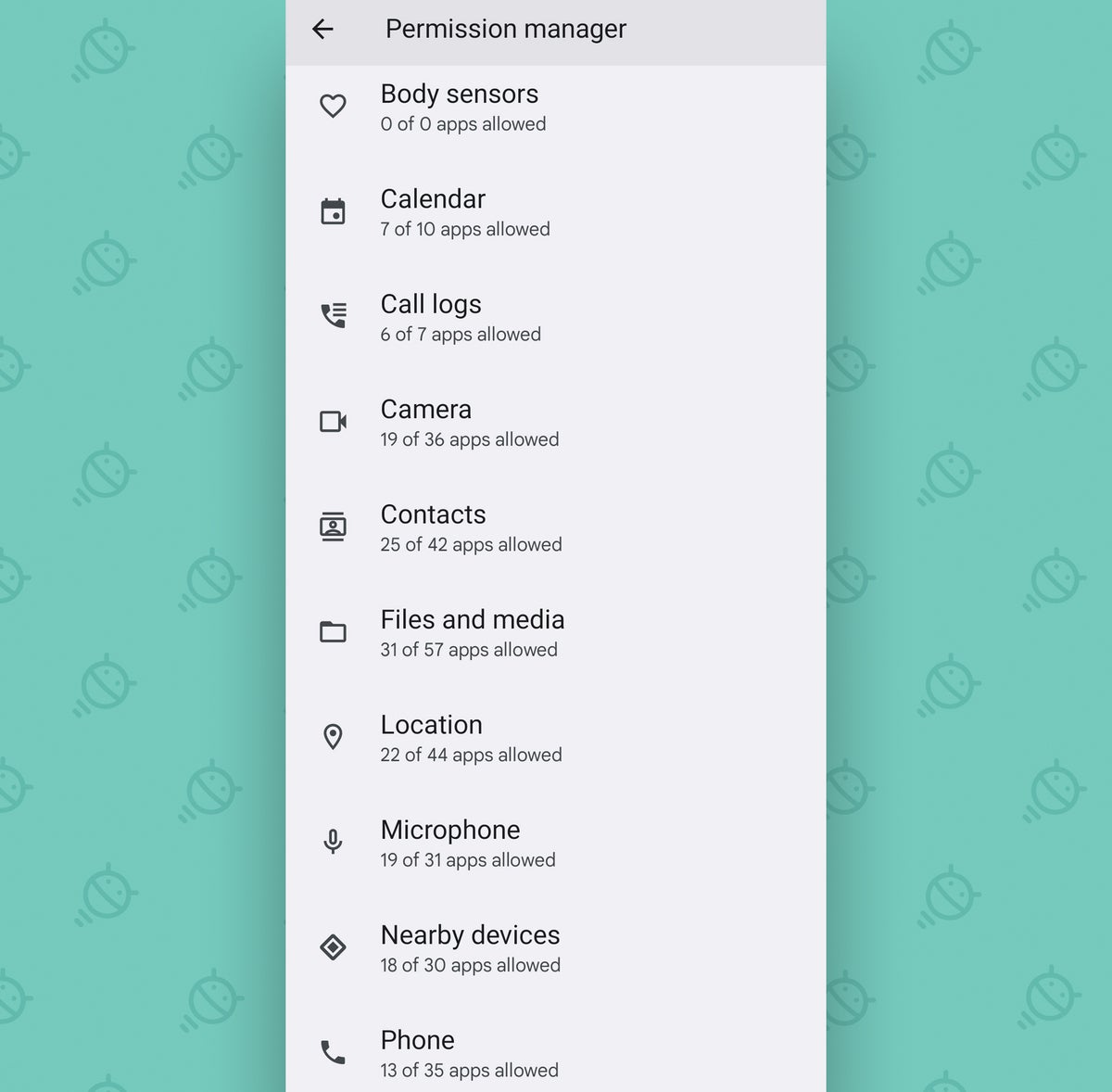
So do this: Caput into the Privacy section of your Android settings and find the "Permission manager" line. That'll show you a list of all available system permissions, including especially sensitive areas such as location, camera, and microphone — the aforementioned 3 areas, incidentally, that tin can be limited to one-time apply only on any telephone running at to the lowest degree Android xi. (And if you lot don't see a "Permission manager" pick on your phone, try looking in the Apps section instead. You tin and so pull up one app at a time there and find its permissions that fashion.)
 JR
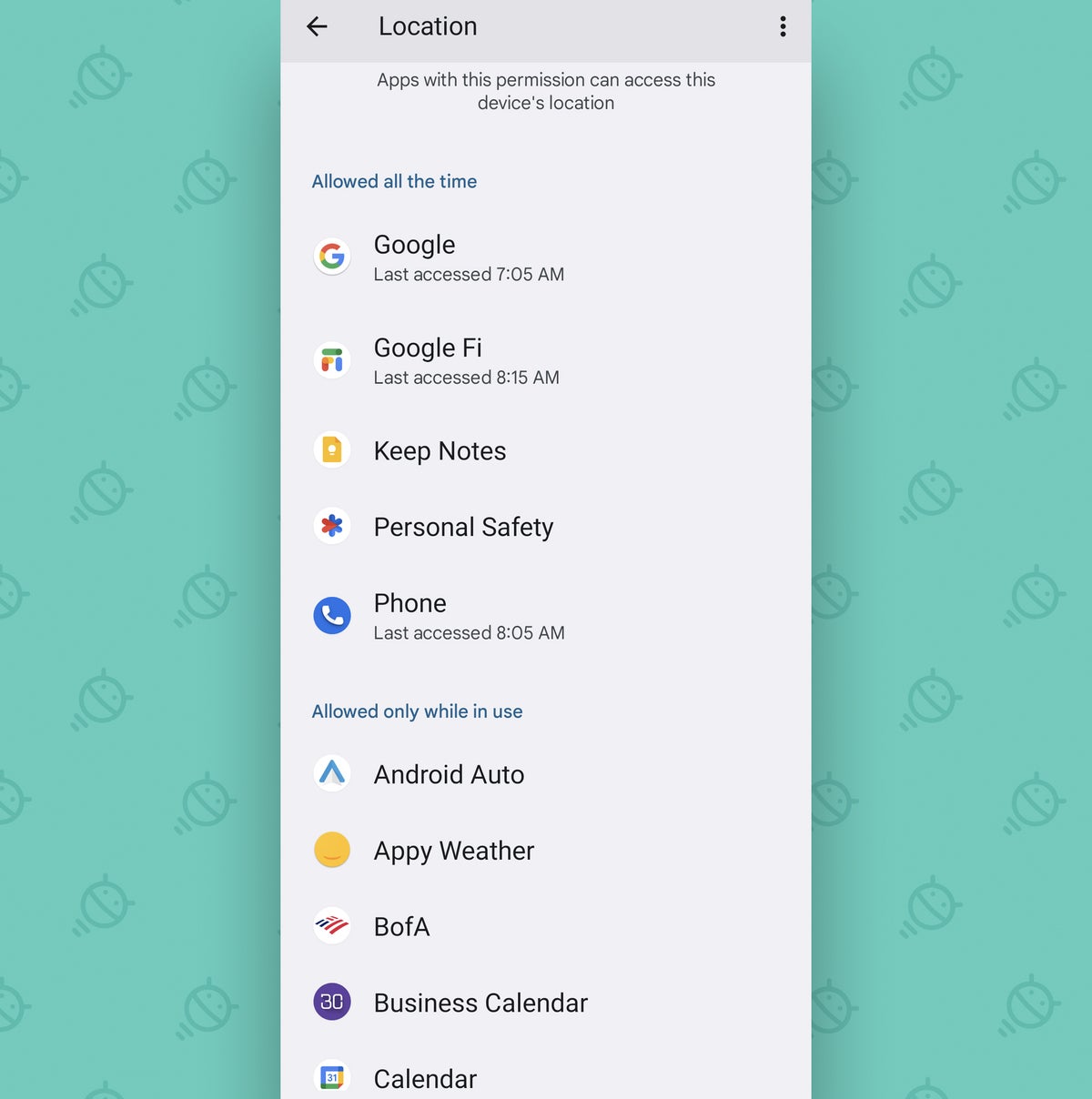
JR Tap on a specific permission, and you'll come across a breakdown of exactly which apps are authorized to use it in what fashion.
 JR
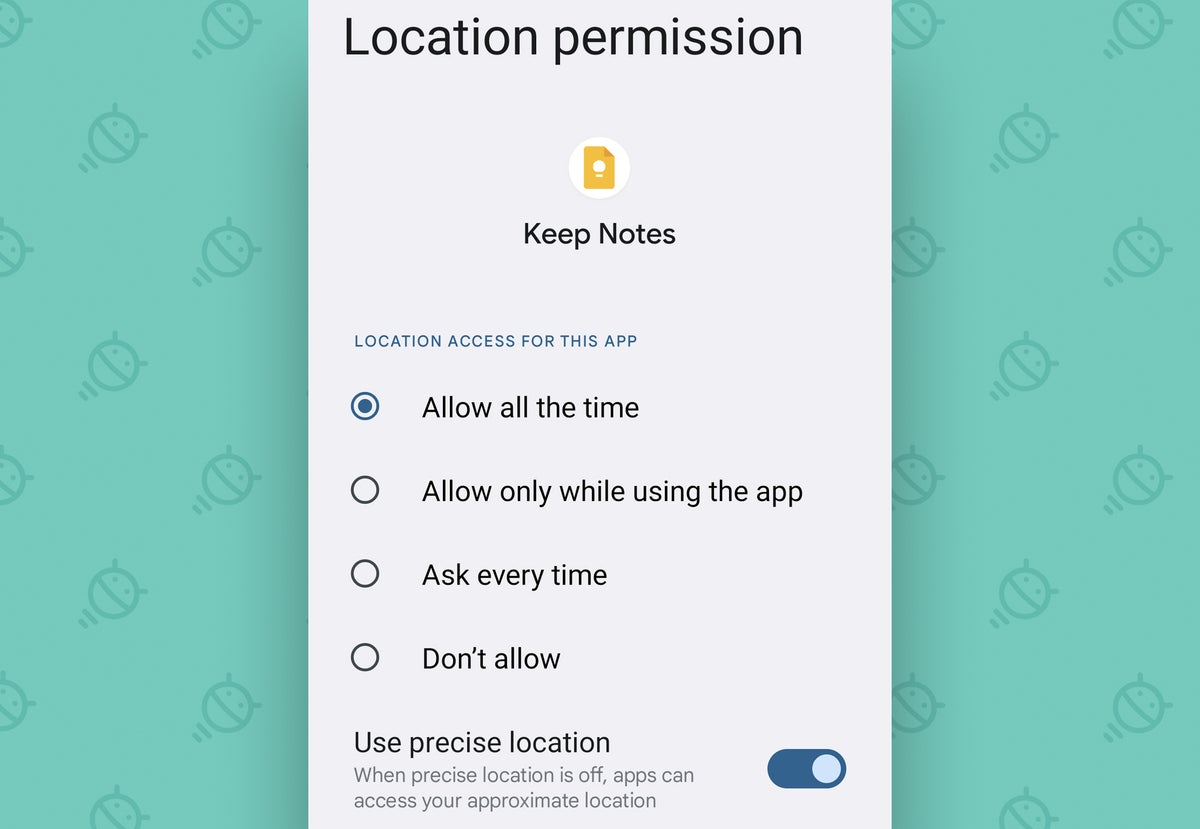
JR Yous can then tap on whatsoever app to adjust its level of access and bring it down a notch, when applicable, or remove its access to the permission entirely — and, if you've got Android 12 or higher, also select whether the app should become admission to your precise location or just a far less specific approximate view of where you lot are.
 JR
JR If there'southward one department of your Android settings worth spending the time to revisit, this is without a doubt it.
Android setting No. ii: Play Protect
Speaking of apps on your telephone, this is a fine time to talk nearly Google Play Protect — Android's native security system that, among other things, continuously scans your telephone for any signs of misbehaving apps and warns you if anything suspicious emerges.
(And yes, it does sometimes fail to notice shady players immediately — something that gets played upward to a comedic caste in those misleading marketing campaigns — but fifty-fifty in those instances, the existent-world threat to nearly folks is typically quite minimal.)
Unless you (or someone else) inadvertently disabled it at some betoken, Play Protect should be up and running on your phone already — but information technology certainly tin can't hurt to double-check and make sure.
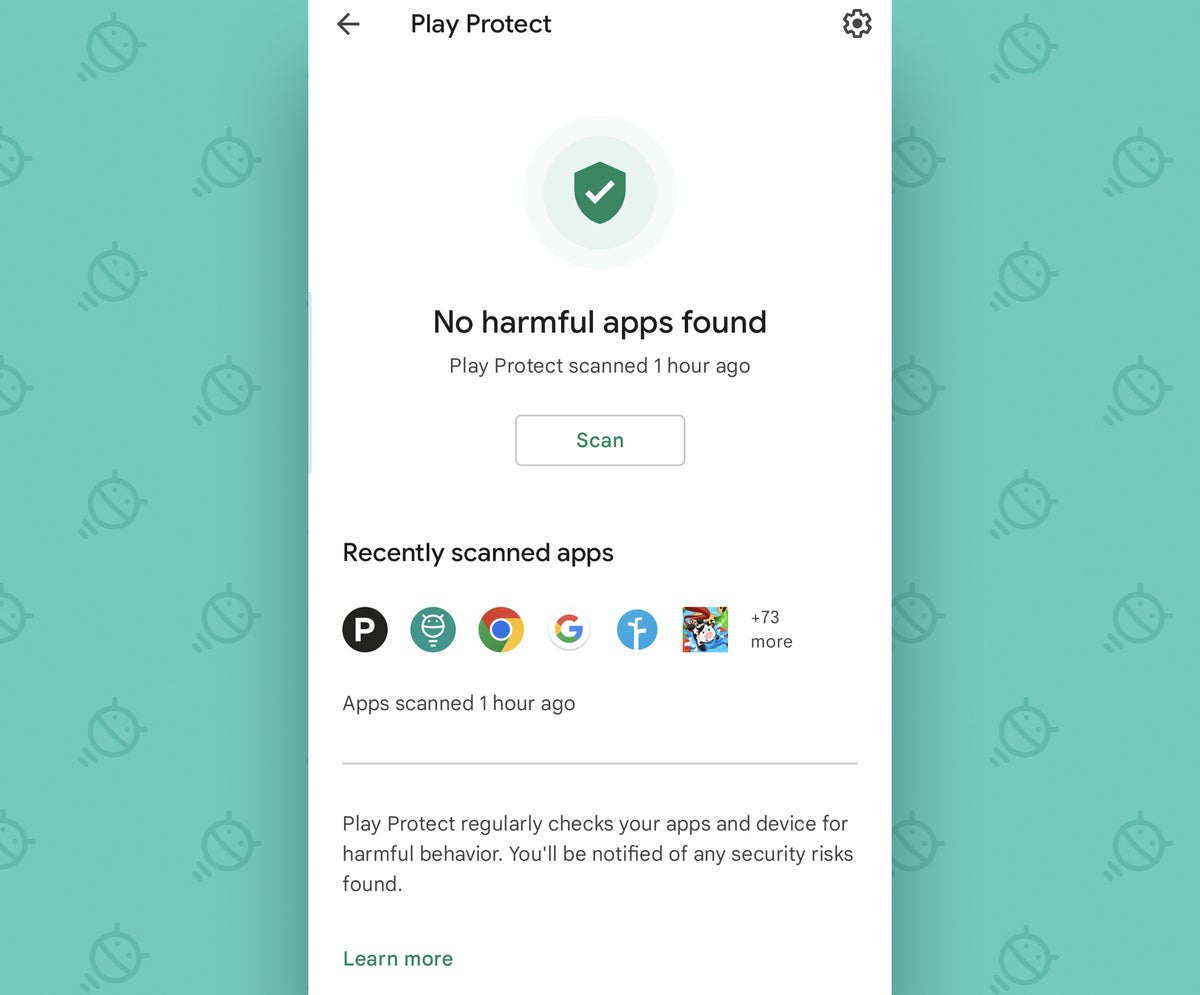
To do so, simply open up the Security section of your Android settings. Tap the line labeled either "Google Play Protect" or "App security," then tap the gear icon in the upper-correct corner and make sure the toggles there are activated.
Dorsum on the main Play Protect screen, you'll see a status update showing yous that the system is active and running. It works entirely on its own, automatically, but you tin always trigger a transmission scan of your apps on that same page, if you lot're ever so inclined (or peradventure just bored).
 JR
JR Android setting No. iii: Safe Browsing
Chrome is typically the default Android browser — and as long as you're using it, you can rest a lilliputian easier knowing information technology'll warn you anytime you attempt to open a shady site or download something dangerous.
While Chrome'due south Safe Browsing mode is enabled by default, though, the app has a newer and more constructive version of the same organisation called Enhanced Safe Browsing. And it's up to you to opt in to it.
Here'south how:
- Open up upwardly Chrome on your phone.
- Tap the three-dot menu icon in the app's upper-right corner and select "Settings" from the bill of fare that comes upwardly.
- Tap "Privacy and security," so select "Prophylactic Browsing."
- Tap the dot next to "Enhanced protection" on the next screen you run across.
While you're there, back yourself out to the chief Chrome settings menu and select "Safety check." That'll reveal a handy ane-tap tool for scanning your various browser settings and saved passwords and letting you know of annihilation that needs attention.
Android setting No. 4: Lock screen info
If someone else ever gets their sweaty paws on your telephone, y'all don't desire 'em to be able to access any of your personal and/or company information — right?
Well, take note: Android typically shows notifications on your lock screen by default — which means the contents of emails or other messages you receive might be visible to anyone who looks at your device, even if they can't unlock information technology.
If y'all tend to become sensitive messages or just want to step up your security and privacy game, you can restrict how much notification info is shown on your lock screen past going to the Privacy department of your Android settings, tapping the line labeled "Notifications on lock screen," so changing its setting from "Show all notification content" to either "Prove sensitive content just when unlocked" (which will filter your notifications and put merely those deemed every bit "not sensitive" onto the lock screen) or "Don't show notifications at all" (which, equally you'd wait, will not show whatsoever notifications on your lock screen whatsoever).
If you're using a Samsung phone, you'll detect those same options within the dedicated Lock Screen department of the organisation settings — though, unfortunately, with less nuance involved (every bit Samsung has for no apparent reason removed the "sensitive" notification differentiation from the settings on its version of Android).
And speaking of the lock screen...
Android setting No. v: Lock screen controls
Past default, Android makes all of the shortcuts in your phone'due south Quick Settings surface area — y'know, that console of one-tap tiles that shows up when you swipe downwards from the top of the screen — bachelor even when the device is locked.
Anything that takes y'all to another area of the operating arrangement will nevertheless require authentication, of course, but the simple on-off tiles can exist tapped and toggled by anyone who'south holding the phone.
More oftentimes than non, that's an added convenience. Say y'all want to flip on your phone'south Bluetooth for a fast connection, for case, or flash on your flashlight to detect that stray cheesy poof that slipped out of your viscid grabbers and vicious onto the flooring. Being able to practise those things with a couple quick taps and without having to unlock your telephone can certainly be handy.
At the aforementioned time, though, it can also let someone elseto do something like alter your phone's audio settings, disable its Wi-Fi connectedness, or even put it into airplane mode. And if y'all're really aiming for the tightest security bachelor, yous probably don't want that sort of stuff to be possible.
Here'south the expert news: If yous've got a device with a contempo Android version, you can take control and turn those controls off in the lock screen surroundings. With Android 12 and upwardly, march into the Display section of your Android settings and tap "Lock screen." Plough the toggle next to the "Testify device controls" option into the off position, and so make a celebratory squawking sound and get yourself a soda.
With Samsung phones, you'll instead need to caput into the Lock Screen department of your settings and tap the line labeled "Secure lock settings." There, y'all'll observe an option to "Lock network and security," which prevents any network-related toggles from being used in that context. (Samsung stripped out the ability to lock downward all Quick Settings tiles, unfortunately, only the network-connected are probably the most important in terms of security, anyway.)
Android setting No. half-dozen: Smart Lock
Security is just useful if you lot really employ it — and given the extra level of inconvenience information technology often adds into our lives, it'due south all likewise piece of cake to let our guards downwards and get lazy later on a while.
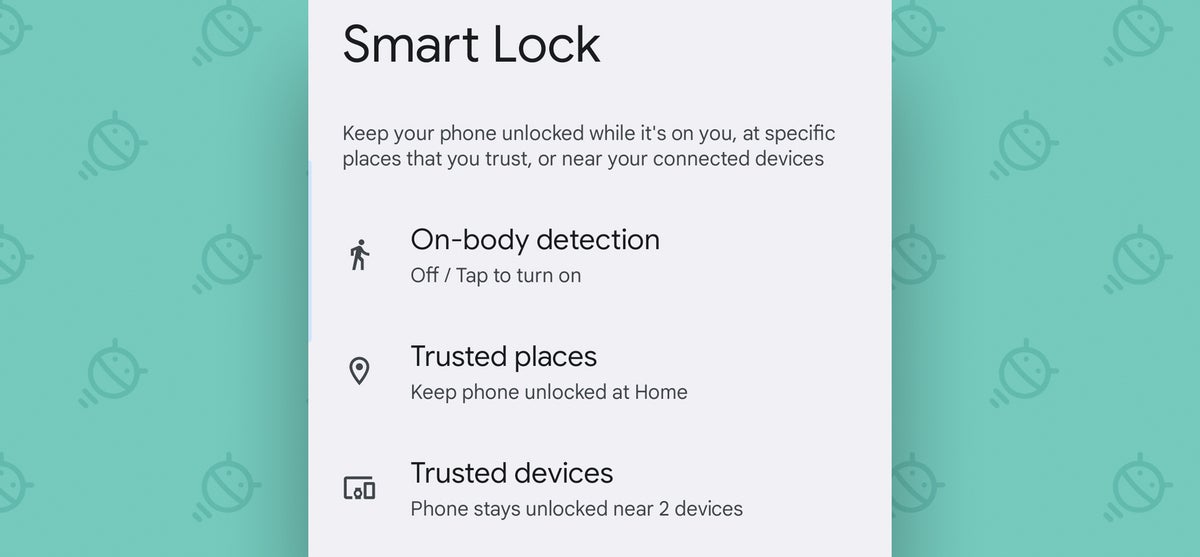
Android's Smart Lock feature is designed to annul that trend past making security a teensy fleck less annoying. It can let you automatically keep your phone unlocked whenever you're in a trusted place — like your home, your role, or that weird-smelling restaurant where you eat barbeque sandwiches almost disgustingly often — or even when you're connected to a trusted Bluetooth device, like a smartwatch, some earbuds, or your car'due south audio organization.
 JR
JR Depending on your device, y'all'll want to look for the "Screen Lock" option in the Security department of your Android settings (with older Android versions), wait under "Advanced settings" within the Security section (with Android 12), or look in the Lock Screen section of your settings (on a Samsung phone) to explore the possibilities.
And if you ever find the Trusted Places part of Smart Lock isn't working reliably, by the fashion, hither's the sixty-second ready .
Android setting No. 7: Ii-factor authentication
This adjacent one'south technically a Google account option and not specific to Android, only information technology's very much continued to Android and your overall smartphone experience.
You know what two-factor authentication is by at present, right? And yous're using it everywhere yous can — especially on your Google account, which is probably associated with all sorts of sensitive data? Correct?!
If yous aren't, by golly, at present's the time to start. Hustle over to the Google section of your Android settings, tap "Manage your Google Account," and then roll across that elevation row to select the "Security" tab. Find and tap "2-Footstep Verification" and follow the steps to ready things upwardly.
For near people, I'd recommend using your telephone's own "Security Key" option every bit the default method, if information technology's bachelor, followed by "Google prompts" and an authenticator app as secondary methods. For that last part, you'll need to download and fix an app similar Google's own Authenticator or the more than flexible Authy to generate your sign-in codes.
If you really want to take your Google account security to the max, yous can besides go a step further and buy a specific standalone hardware key that'll control the procedure and be required for any successful sign-in to occur.
It'll add an extra step into your sign-in process, but this is 1 area where the minor inconvenience is very much worth the tradeoff for enhanced protection.
Android setting No. 8: Lockdown mode
Provided you're using a phone with Android 9 or college (and if you aren't, switching over to a electric current phone that actually gets active software updates should be your tiptop security priority!), an Android setting called lockdown mode is well worth your while to investigate. In one case enabled, it gives you an piece of cake manner to temporarily lock down your phone from all biometric and Smart Lock security options — significant only a pattern, Pivot, or countersign tin can get a person by your lock screen and into your device.
The idea is that if you were ever in a situation where you idea you might be forced to unlock your phone with your fingerprint or confront — be information technology by some sort of law enforcement amanuensis or only by a regular ol' hooligan — y'all could actuate the lockdown mode and know your information couldn't be accessed without your explicit permission. No notifications volition ever show up on your lock screen while the mode is active, and that heightened level of protection will remain in place until you manually unlock your telephone (even if the device is restarted).
The fob, though, is that on certain phones — particularly those that shipped with earlier Android versions and were upgraded to Android 9 at some point — you have to enable the option alee of time in order for it to exist available. To confirm that it's activated on your device, open up your Android settings, search for the give-and-take lockdown, and brand sure the toggle aslope "Show lockdown pick" is fix to the on position.
If y'all're using a electric current phone and don't run into any results for that search, the option is probably but automatically enabled — and yous shouldn't have to do anything to make it available.
Either way, once the organization's up and running, you should meet a command labeled either "Lockdown" or "Lockdown manner" someday you printing and concur your phone's ability push. With any luck, you'll never need it. Merely information technology'southward a skilful added layer of protection to have bachelor, simply in example — and at present y'all know how to notice it.
Android setting No. 9: App pinning
I of Android's virtually practical settings is likewise ane of its most subconscious. I'm talkin' about app pinning — something introduced mode dorsum in 2022's Lollipop era and rarely mentioned since.
App pinning makes it possible for you to lock a single app or process to your phone and and so require a password or fingerprint hallmark before annihilation else can be accessed. It can be invaluable when you pass your phone off to a friend or colleague and desire to be sure they don't accidentally (or perhaps not so accidentally) get into something they shouldn't.
To use app pinning, you lot'll showtime need to activate it by opening that trusty ol' Security department in your Android settings and so finding the line labeled "App pinning," "Screen pinning," or peradventure "Pivot windows." (You'll probably accept to tap a line labeled "Advanced settings" or "Other security settings" to reveal it.) Tap those words, whatever they are on your specific device, and then turn the feature on and as well brand certain the toggle to "Ask for unlock blueprint before unpinning" is activated.
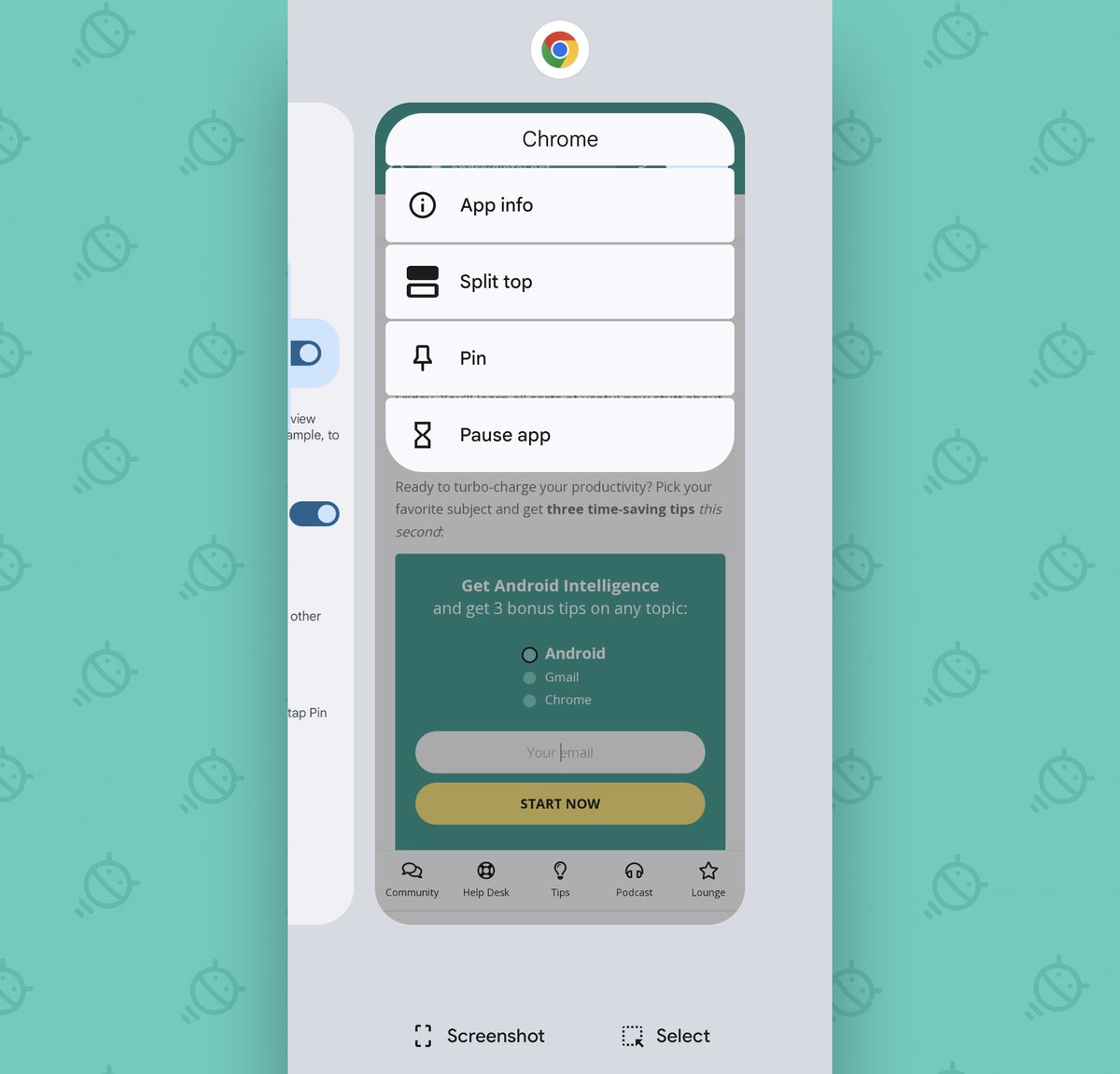
Then, the adjacent time y'all're nigh to identify your telephone in someone else'due south grubby hands, first open up upwardly your organisation Overview interface — either by swiping up from the bottom of your screen and holding your finger down, if you're using Android'south gesture system, or by pressing the square-shaped button, if yous're yet hanging onto the old-schoolhouse iii-button nav setup.
On whatsoever telephone running reasonably recent software, yous'll then tap the icon of the app you want to pin, straight above its card in that Overview surface area. And there, you should see the Pivot option.
 JR
JR One time you lot've tapped that, you won't be able to switch apps, go dorsum to your domicile screen, look at notifications, or practise annihilation else until yous exit the pinning and unlock the device. To exercise that, with gestures, you'll swipe upwards from the bottom of your screen and agree your finger down — and with the old three-button nav setup, you'll press the Back and Overview buttons at the same time.
Android setting No. ten: Invitee Mode
If you want to go a footstep further and let someone else use all parts of your phone without ever encountering your personal data or being able to mess annihilation up, Android has an incredible organization that'll let you lot practise just that — with next to no ongoing effort involved.
It's called Invitee Mode, and information technology's been around since 2022, despite the fact that most folks take completely forgotten almost it. For a detailed walkthrough of what it's all about and how you can put it to use, see my separate Android Guest Mode guide .
But note that if you have a Samsung phone, that guide won't practise y'all much good — every bit Samsung has for no apparent reason opted to remove this standard operating system element from its software (insert tangentially related discourse rant hither). On Google'south ain Pixel phones and many other Android devices, though, it'll take you all of 20 seconds to set upwards and go ready.
Android setting No. xi: Detect My Device
Whether you've simply misplaced your telephone around the firm or office or you've really lost it out in the wild, ever remember that Android has its own built-in mechanism for finding, ringing, locking, and even erasing a device from distant.
Like Play Protect, the Android Find My Device feature should be enabled by default. You can brand certain by heading into the Security department of your Android settings and tapping the line labeled "Find My Device." Double-bank check that the toggle at the top of the screen is turned on.
Using a Samsung telephone? Samsung provides its ain superfluous, redundant service called Find My Mobile, but the native Google Android version will bring all of your devices — non only those fabricated by Samsung — together into a unmarried place. and it'southward besides much more versatile in how and where it's able to work. On a Samsung device, the easiest way to discover the Android Find My Device setting is to search your system settings for the phrase Find My Device.
Once you've confirmed the setting is enabled, if yous ever need to track your phone down, just become to android.com/detect from whatever browser or do a Google search for "find my device." (There'southward also an official Find My Device Android app, if you have another Android device and desire to keep that function standing by and fix.)
Equally long as you're able to sign into your Google account, yous'll be able to pinpoint your phone'south terminal known location on a map and manage information technology remotely within a matter of seconds.
Android setting No. 12: Emergency contact
Detect My Device is a fantastic resource to have — but in sure situations, y'all might get a missing telephone back even faster with the help of a fellow human.
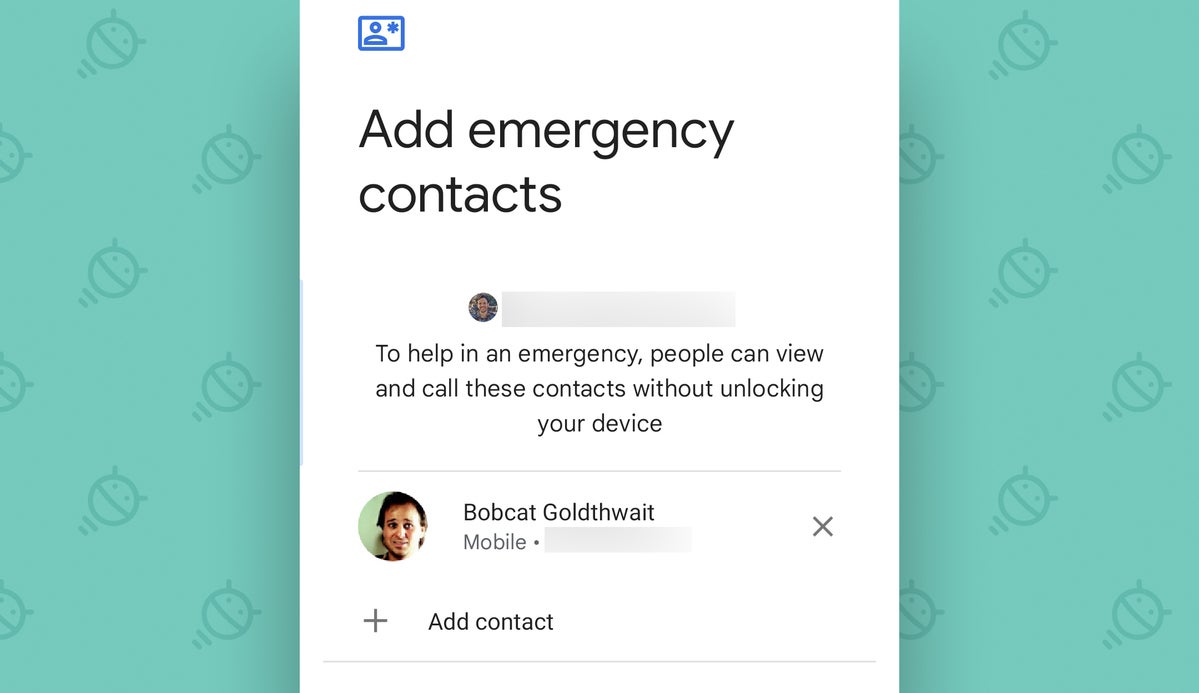
Requite people a risk to do the right matter by adding an emergency contact that can exist accessed and dialed with a few quick taps from your phone's lock screen. To showtime, get to either the Nigh Phone section of your Android settings or the Safety & Emergency department, if you have it, and then find and tap the line labeled either "Emergency information" or "Emergency contacts."
Follow the prompts there to add in an emergency contact — a close friend, family unit member, pregnant other, random raccoon, or whatever makes sense for you. (Hey, I'm not hither to judge.)
 JR
JR Easy peasy, right? Well, almost: The only challenge is that the emergency contact info isn't exactly obvious or simple to find on the lock screen — go figure — then anyone who picks up your phone might not fifty-fifty notice information technology.
But look! You can increment the odds considerably with one extra pace: Head into the Display section of your settings and tap "Lock screen" (which may exist hidden within an "Advanced" subsection, depending on your device), then tap the line labeled "Add text on lock screen."
However you get there, once you find yourself facing a blank space for text input, enter something along the lines of: "If you've plant this phone, please swipe upwards and then tap 'Emergency call' and 'View emergency information' to notify me."
That bulletin will and then ever show up on your lock screen — and as an added bonus, if at that place's ever an actual emergency, you'll exist ready for that, too.
Using a Samsung phone? For no apparent reason (sensing a theme hither?), Samsung has removed the direct emergency contact system and instead offers just the ability to place manifestly text on your lock screen. You can find that, though, by making your way into the Lock Screen section of your organization settings and looking for the line labeled "Contact data" — and there, you can just type in your emergency contact info directly and hope that someone finds information technology and so dials it from their own telephone.
1 more than thing...
Now that y'all've got your Android security settings optimized and in society, take 10 minutes to perform an Android security checkup. It'southward a 16-step process I've created for the state of security on both your telephone and your broader Google account — and it'south well worth doing at least one time a year.
The best part of this checkup? Information technology's completely painless — and unlike with nearly preventative exams, removing your pants is entirely optional.
Get even more than Googley knowledge with my Android Intelligence newsletter — three new things to try every Friday and 3 custom tips on your favorite topic right now.
Copyright © 2022 IDG Communications, Inc.
Source: https://www.computerworld.com/article/3268079/android-settings-security.html
0 Response to "How To Lock Settings On Android Phone"
Post a Comment